The Milky Way Galaxy isn’t just a cosmic swirl of stars; it’s the ultimate celestial playground. Imagine zipping through a vast expanse filled with over 100 billion stars, each one vying for your attention like an overzealous puppy. From its spiral arms to its mysterious black hole at the center, this galaxy offers a front-row seat to the wonders of the universe.
But don’t let its beauty fool you. The Milky Way is a complex and chaotic environment, where stellar birth and death happen at a dizzying pace. It’s a place where science fiction dreams come to life, and who wouldn’t want to explore that? Buckle up as we dive into the fascinating facts and quirky features that make the Milky Way a must-know for any aspiring stargazer or cosmic enthusiast.
Overview of the Milky Way Galaxy
The Milky Way Galaxy is a vast and intricate cosmic system. It houses over 100 billion stars along with various celestial entities.
Structure and Components
Spiral arms extend outward from the center, where a supermassive black hole resides. These arms host clusters of stars, nebulae, and star-forming regions. Interstellar gas and dust roam between stars, contributing to the galaxy’s dynamic environment. Globular clusters, containing thousands of ancient stars, orbit the galactic core. Dark matter plays a significant role in its structure, influencing gravitational interactions and overall formation.
Size and Scale
The Milky Way spans approximately 100,000 light-years in diameter. Its thickness ranges from 1,000 to 3,000 light-years. At its core, the supermassive black hole, known as Sagittarius A*, measures about 4.1 million solar masses. Composed primarily of stars, gas, and dust, the galaxy’s mass estimates reach up to 1.5 trillion solar masses. The galaxy’s rotation period varies, taking about 230 million years to complete one orbit around the center.
The Formation of the Milky Way Galaxy
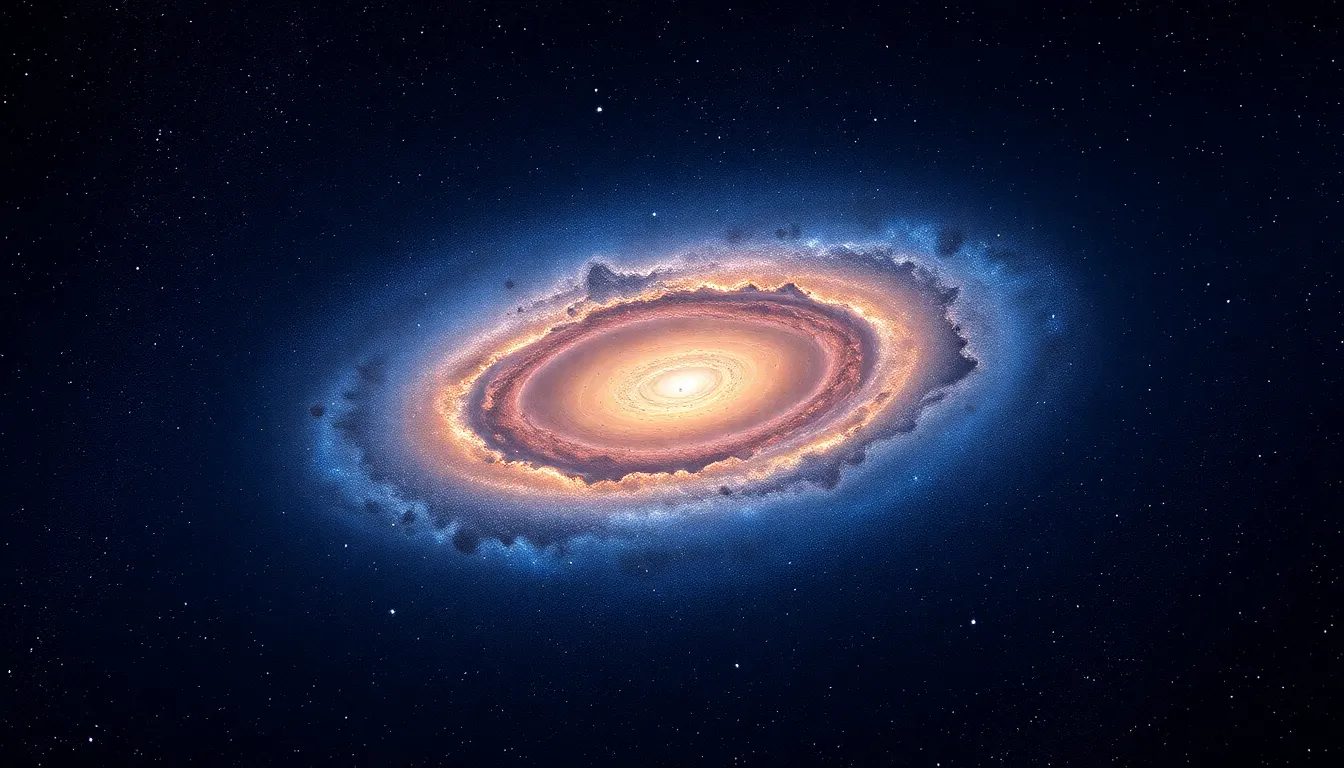
The formation of the Milky Way Galaxy presents a fascinating timeline of cosmic evolution. Understanding its origins involves exploring various theories and key events that shaped this grand structure.
Theories of Origin
Two primary theories explain how the Milky Way came to be. The first suggests that the galaxy formed during the early universe from a massive gas cloud that collapsed under gravity. This process, known as hierarchical merging, involved smaller structures combining to create larger ones. The second theory emphasizes the role of dark matter. It posits that dark matter’s gravitational influence was essential for the initial formation and continued development of the galaxy. Current research supports both theories, showcasing the complexity of galactic formation.
Key Events in Formation
Significant events marked the Milky Way’s formation over billions of years. About 13.6 billion years ago, primordial gas and dust began coalescing, leading to the formation of the first stars. Stellar birth rates peaked, creating clusters that enriched interstellar matter. Around 8 billion years ago, interactions with neighboring galaxies contributed to the Milky Way’s growth. The merger with smaller star systems enhanced its mass and complexity. Finally, the formation of the spiral arms and the central black hole, Sagittarius A*, defined its current structure. Each event added layers to the galaxy’s dynamic history.
Stars and Stellar Phenomena
The Milky Way Galaxy hosts a diverse array of stars and stellar phenomena, captivating astronomers and stargazers alike.
Types of Stars in the Milky Way
Main sequence stars dominate the Milky Way, primarily composed of hydrogen and helium. Red dwarfs, a common type, account for roughly 70% of the galaxy’s stellar population. Additionally, massive stars exist but represent a smaller percentage, burning bright and fast. White dwarfs, remnants of stars that have exhausted their nuclear fuel, also populate the galaxy. Neutron stars and black holes arise from the remnants of supernovae, adding to the galaxy’s complexity. Diverse stellar classifications, from O-type hot blue stars to M-type cool red stars, showcase the variety present in the galaxy.
Supernovae and Stellar Evolution
Supernovae mark the explosive end of massive stars’ lives. Such events contribute to the cosmic cycle of matter, dispersing elements like carbon and oxygen into space. Following a supernova, a neutron star or black hole may form, depending on the original star’s mass. Stellar evolution illustrates the life cycle of stars, transitioning from protostar to main sequence, and potentially to red giant before explosion. Each stage reveals unique characteristics, demonstrating the galaxy’s dynamic nature. Supernova remnants often give rise to new star-forming regions, linking death with rebirth in the cosmos.
The Milky Way’s Place in the Universe
The Milky Way galaxy occupies a central position in the cosmic tapestry, distinguishing itself through its structure and population.
Comparison with Other Galaxies
The Milky Way is a barred spiral galaxy, setting it apart from others like elliptical or irregular galaxies. In terms of size, it ranks among the largest galaxies in the local universe, second only to the Andromeda Galaxy. Over 100 billion stars inhabit both, yet their structures differ significantly. While the Milky Way features well-defined spiral arms, many elliptical galaxies boast a more rounded shape. Studies suggest the Milky Way showcases a rich variety of stellar populations, unlike certain galaxies that host primarily old stars. Its active star formation rates also add to its distinction, further enriching its dynamic environment.
Local Group and Beyond
The Milky Way belongs to the Local Group, a collection of more than 54 galaxies, including Andromeda and the Triangulum Galaxy. This group spans roughly 10 million light-years, highlighting the close relationship of its members in the cosmic scale. Within this region, gravitational interactions define orbital paths and influence structure. The Milky Way itself serves as a gravitational centerpiece, interacting with its neighbors, shaping their evolution. Beyond the Local Group, it participates in the larger Virgo Supercluster, which contains thousands of galaxies. Research indicates the structure and motions of these galaxies reveal insight into the universe’s expansion, emphasizing the Milky Way’s significance in a broader cosmic context.
The Milky Way Galaxy stands as a testament to the wonders of the universe. Its intricate structure and dynamic processes reveal a cosmos teeming with life and energy. From the birth of stars to the influence of dark matter, every aspect contributes to its ongoing evolution.
As a barred spiral galaxy, the Milky Way not only captivates astronomers but also invites curious minds to explore its depths. Understanding its complexities enhances appreciation for our place in the universe. With each discovery, the galaxy continues to inspire awe and ignite the imagination of stargazers everywhere.