Imagine walking through your favorite city and having directions pop up right in front of you, like a personal tour guide who never gets lost. Augmented reality glasses are here to turn that dream into reality. These sleek devices don’t just sit on your nose; they transform the way you interact with the world. Whether you’re a gamer looking to level up your experience or a busy professional wanting to streamline your tasks, AR glasses are the next big thing.
Overview of Augmented Reality Glasses
Augmented reality glasses blend digital information with the physical world, creating an interactive experience. These devices enhance everyday activities, making tasks like navigation and gaming more immersive.
What Are Augmented Reality Glasses?
Augmented reality glasses display digital content overlaid on a user’s field of view. Real-time data, images, or animations enhance the user’s environment, providing relevant information without interrupting their surroundings. Users wear these lightweight devices like traditional eyewear, enabling hands-free interaction. Popular examples include the Microsoft HoloLens and Google Glass.
Key Technologies Behind AR Glasses
Key technologies drive the functionality of augmented reality glasses. Advanced optics, such as waveguides and microdisplays, project images onto the lenses. Sensors, including depth sensors and cameras, detect the user’s environment, facilitating accurate digital overlays. Additionally, powerful processors ensure swift data processing, enabling seamless interactions. Gesture recognition and voice control enhance user experience and accessibility.
Benefits of Augmented Reality Glasses
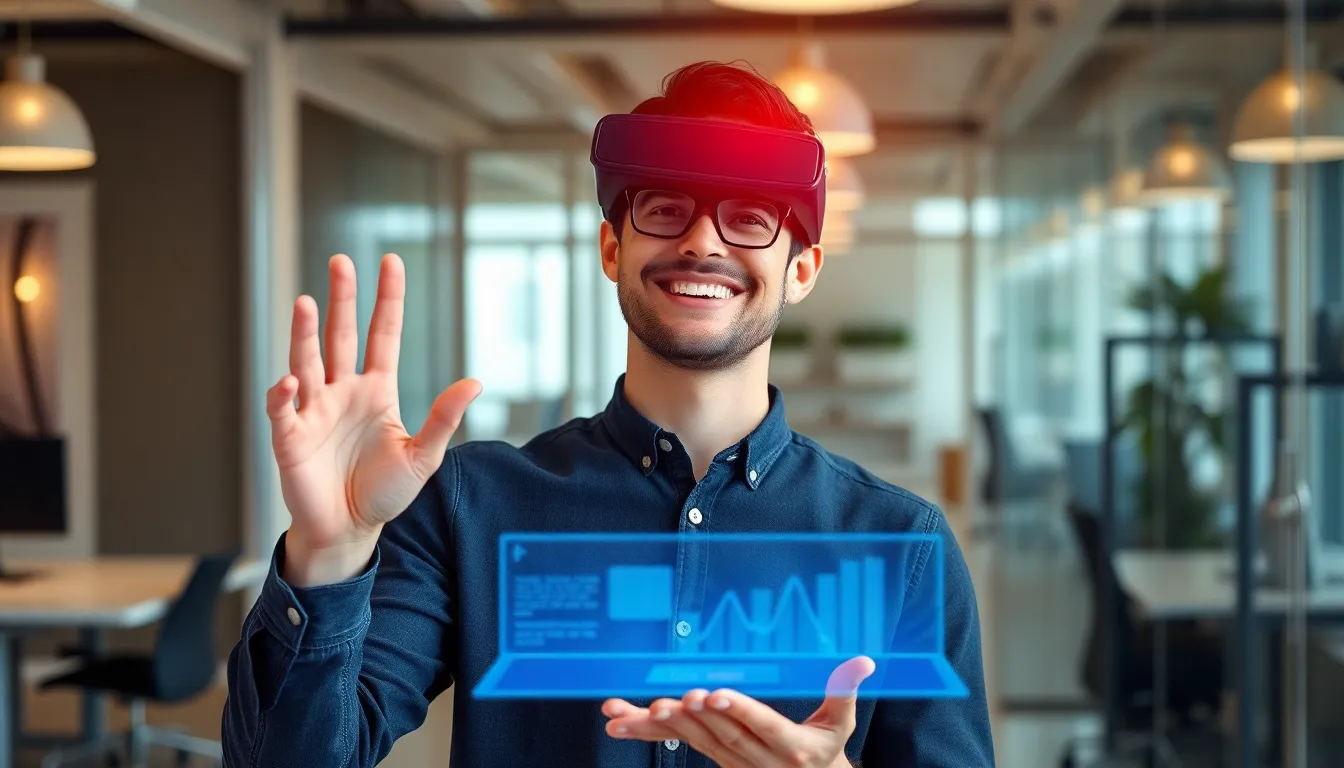
Augmented reality glasses provide significant advantages that enhance daily interactions with technology. They create immersive experiences while offering practical benefits across various sectors.
Enhanced User Experience
AR glasses deliver a seamless blend of digital content and the physical environment, enhancing engagement and interaction. Users access real-time information without needing additional screens. Visual displays overlay navigation prompts and notifications, guiding them effectively. Gesture and voice controls ensure hands-free operation, allowing users to interact naturally. Game enthusiasts enjoy more immersive experiences as game elements merge with reality. Overall, these advancements shape how users interact with their surroundings.
Practical Applications in Various Industries
Different industries leverage AR glasses for improved functionality and efficiency. In healthcare, surgeons utilize AR for enhanced visualization during procedures, which aids precision. Retail businesses implement AR to provide virtual try-ons, increasing customer satisfaction and reducing return rates. Construction teams adopt AR for project visualization, resulting in better planning and collaboration. Logistics companies use AR glasses for optimized warehousing tasks, enabling faster inventory checks. Education integrates AR glasses to enhance learning experiences, bringing subjects to life. Each application highlights the versatility and value AR glasses bring across numerous fields.
Popular Augmented Reality Glasses on the Market
Several augmented reality glasses have gained traction in the market, each offering unique features and capabilities.
Google Glass
Google Glass marked a significant leap in wearable technology. Designed initially for developers, this device provides hands-free access to information. Users can get notifications, record videos, and navigate directions, all while maintaining their focus on the physical world. The device incorporates voice commands for intuitive interaction and features a small display that overlays vital information. Despite its initial commercial limitations, Google Glass found a niche in enterprise applications, particularly in fields like healthcare and manufacturing.
Microsoft HoloLens
HoloLens stands out for its robust mixed reality capabilities. It offers builders and designers an immersive experience that blends virtual elements with reality. Users interact with holograms in their environment, enhancing collaboration and creativity in the design process. HoloLens boasts advanced spatial mapping, allowing it to recognize and adapt to surroundings seamlessly. It has become indispensable in sectors like architecture and engineering, where 3D modeling and visualization elevate project outcomes.
Magic Leap One
Magic Leap One positions itself as a contender in the augmented reality space with its exceptional visual quality. This device focuses on providing a rich visual experience by delivering vibrant colors and detailed graphics. Users experience a spacious field of view, making interactions feel more natural. The headset also features spatial computing capabilities, allowing for intuitive gesture controls. Magic Leap One’s potential spans various applications, including gaming, education, and enterprise solutions, catering to both entertainment and professional needs.
Challenges and Limitations
Augmented reality glasses face several challenges and limitations that impact their adoption and effectiveness. These hurdles include technical constraints and privacy concerns.
Technical Limitations
AR glasses often struggle with processing power and battery life. Many devices can’t support high-demand applications for extended periods without depleting power quickly. Connectivity issues may also occur, leading to interruptions in data streaming and information display. Display quality presents another challenge; users frequently note difficulties when viewing content in bright outdoor conditions. Additionally, the integration of advanced features such as gesture recognition requires sophisticated sensors that increase device complexity and cost. Overall, these technical limitations hinder the user experience and can restrict wide-scale adoption.
Privacy Concerns
Privacy concerns significantly impact the public perception of AR glasses. Users often worry about the potential for unauthorized recording and surveillance, as many AR glasses come equipped with cameras. Such capabilities can raise ethical questions about consent and the protection of personal information. Furthermore, individuals may feel uneasy about being monitored in public spaces. Regulation of data usage remains an ongoing debate, as developers and manufacturers must navigate laws concerning privacy while creating innovative features. Addressing these concerns proactively is essential for fostering trust and encouraging broader acceptance of AR technology.
Future of Augmented Reality Glasses
Anticipated advancements in augmented reality glasses promise to transform user interactions. Expectations include enhanced display technologies offering brighter, higher-resolution visuals. Improvements in battery life will enable longer usage without constant recharging. Innovations in AI could lead to more personalized experiences, adapting content to individual user needs. Integration with 5G technology is also likely to provide seamless access to data, enhancing functionality in real-time applications. Moreover, advancements in lightweight materials could improve comfort for extended wear.
Potential market growth for augmented reality glasses appears promising. Analysts project a compound annual growth rate of over 30 percent for the AR glasses market from 2023 to 2030. This growth is driven by increasing adoption in industries like healthcare, education, and entertainment. Businesses are recognizing the efficiency and immersive capabilities that AR glasses provide. Consumer interest is also rising, with many individuals seeking enhanced interactive experiences. As technology improves and prices decrease, broader acceptance of AR glasses in everyday life is expected.
Augmented reality glasses are set to redefine how people interact with their environments. With their ability to overlay digital information seamlessly onto the physical world they offer unprecedented opportunities across various sectors. As advancements continue to address current limitations such as processing power and privacy concerns the potential for widespread adoption grows.
The future of AR glasses looks bright with expectations for enhanced features and greater integration into daily life. Their applications in healthcare education and entertainment highlight their versatility and promise. As technology evolves and becomes more accessible users can anticipate a richer more immersive experience that transforms everyday activities.