Planetary science isn’t just for rocket scientists and space nerds; it’s the cosmic soap opera that keeps everyone on the edge of their seats. Picture this: a universe filled with planets, moons, asteroids, and the occasional wayward comet, all playing their roles in a grand celestial drama. From the fiery storms of Jupiter to the icy rings of Saturn, each body has its own story, and they’re just waiting to be discovered.
Overview of Planetary Science
Planetary science encompasses the study of celestial bodies and their interactions. This field examines planets, moons, asteroids, comets, and other objects in the solar system and beyond.
Definition and Importance
Planetary science involves various scientific disciplines, including geology, atmospheric science, and astronomy. This discipline plays a critical role in understanding the formation and evolution of celestial bodies. By investigating planetary environments, researchers gain insights into potential habitability and the origins of life. Understanding astrobiology connects planetary science to broader questions about life beyond Earth. Insights from this field can inform future exploration endeavors and enhance technological advancements.
Key Areas of Research
Astrobiology represents a significant area of focus in planetary science. It investigates the potential for life in extreme environments. Planetary geology explores the surface processes and composition of planets and moons. Researchers study planetary atmospheres to understand climate patterns and weather phenomena. Comparative planetology compares various celestial bodies to identify differences and similarities. Finally, space missions provide invaluable data, revealing new information about our solar system and beyond.
The Solar System and Beyond
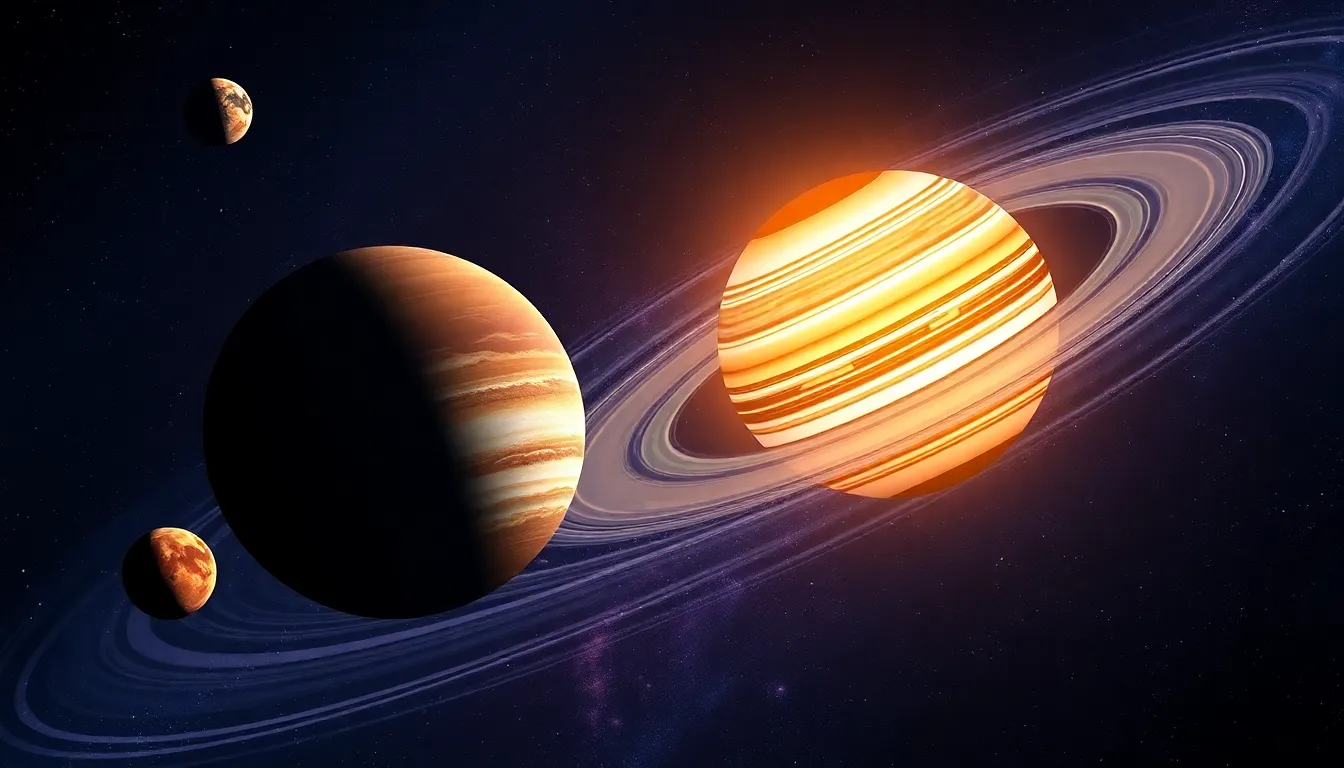
The solar system invites exploration of its diverse celestial landscapes. Both inner and outer planets reveal fascinating differences.
Inner vs. Outer Planets
Inner planets, Mercury, Venus, Earth, and Mars, boast rocky surfaces and are relatively small. Terrestrial properties define these planets, with solid crusts and diverse geological features. In contrast, outer planets, Jupiter, Saturn, Uranus, and Neptune, feature gaseous compositions, exemplifying gas giants and ice giants. Massive sizes characterize them, with intricate atmospheric phenomena. Unique ring systems and numerous moons distinguish the outer planets, showcasing complexity beyond their inner counterparts. Studying these distinctions provides insights into planetary formation and evolutionary processes.
Exoplanets and Their Significance
Exoplanets offer a glimpse into worlds beyond our solar system. Thousands of exoplanets, identified through advanced telescopes, expand understanding of planetary diversity. Various detection methods, including transit and radial velocity techniques, uncover their presence. Significantly, these discoveries inform theories regarding planetary habitability and the potential for life beyond Earth. Studying exoplanet atmospheres reveals vital information about their composition and climatic conditions. The ongoing search for Earth-like exoplanets in habitable zones fuels astronomical research. By examining these distant worlds, scientists enhance knowledge of planetary systems and the conditions required for life.
Methodologies in Planetary Science
Planetary science employs various methodologies to explore celestial bodies effectively. Understanding these techniques enhances insights into the universe’s complexity.
Observation Techniques
Observation techniques play a crucial role in planetary science. Astronomers utilize ground-based and space-based telescopes to gather data. Ground-based observatories, like Mauna Kea, provide high-resolution imaging of celestial phenomena. Space telescopes, such as Hubble and James Webb, offer unobstructed views beyond Earth’s atmosphere. Both types allow scientists to study light spectra, revealing compositions and temperatures of distant planets. Imaging techniques, like radar and infrared, facilitate the analysis of surface features and atmospheric conditions. These observations lead to detailed knowledge about planets, moons, and other significant celestial bodies.
Data Collection and Analysis
Data collection and analysis form the backbone of planetary science research. Instruments aboard spacecraft take comprehensive measurements, including temperature, pressure, and chemical composition. For example, rovers on Mars collect soil and rock samples, enabling in-depth investigation of planetary geology. After gathering data, scientists employ advanced statistical methods to analyze findings. They apply machine learning algorithms to identify patterns in vast datasets, enhancing their understanding of intricate planetary systems. Rigorous peer review ensures the reliability of research conclusions, fostering collaboration among researchers worldwide. Through precise data analysis, planetary scientists continually refine theories about the universe and its origins.
Recent Discoveries and Innovations
Recent advancements in planetary science significantly enhance understanding of celestial bodies. Innovations in technology and methodologies have propelled exploration efforts forward.
Mars Exploration
Mars exploration has seen groundbreaking progress with missions like Perseverance Rover and Ingenuity helicopter. These missions aim to discover signs of past life, analyze soil samples, and test technologies for future human missions. The rover’s high-resolution cameras provide detailed images of the Martian surface, revealing geological features like ancient riverbeds. Ingenuity’s successful flights demonstrate the feasibility of aerial exploration on other planets. Ongoing data analysis from both missions continues to yield insights into Mars’ climate and geology, advancing knowledge of planetary habitability.
Moons of Jupiter and Saturn
The study of Jupiter and Saturn’s moons has unveiled new possibilities for astrobiology. Europa, with its subsurface ocean, holds potential for harboring life, prompting increased focus on future missions. Ganymede, the largest moon in the solar system, displays distinct geological features and a magnetic field. Meanwhile, Saturn’s moon Enceladus has shown geysers emitting water vapor and organic molecules into space, indicating a subsurface ocean beneath its icy crust. These discoveries from missions like Juno and Cassini enrich understanding of the conditions that could support life beyond Earth.
The Future of Planetary Science
Planetary science faces an exciting era filled with opportunities for discovery and innovation. Upcoming missions and emerging technologies promise to deepen understanding of the universe.
Upcoming Missions
Numerous missions are on the horizon, each aiming to expand knowledge of celestial bodies. NASA plans to launch the Europa Clipper, tasked with studying Europa’s icy surface and potential subsurface ocean. Meanwhile, the Artemis program emphasizes returning humans to the Moon, paving the way for lunar exploration. ESA’s JUICE mission focuses on Ganymede and other moons of Jupiter, hoping to uncover conditions that might support life. Missions like these not only gather critical data but also inspire future generations of scientists. They build on previous explorations, advancing the quest for habitable environments beyond Earth.
Emerging Technologies
Rapid advancements in technology transform the landscape of planetary science. Autonomous drones and rovers equipped with sophisticated sensors facilitate detailed surface analysis on planets like Mars. Innovations in remote sensing allow scientists to analyze atmospheric compositions from vast distances more effectively. Next-generation telescopes, such as the James Webb Space Telescope, unveil new details about distant exoplanets and their potential for life. Furthermore, artificial intelligence plays a crucial role in processing vast amounts of data, enhancing research capabilities. These technologies not only improve data collection but also refine strategies for interplanetary missions.
Planetary science stands at the forefront of humanity’s quest to understand the cosmos. With each mission and discovery, it unveils the mysteries of celestial bodies and their potential to harbor life. The ongoing advancements in technology and methodologies not only enhance our knowledge but also inspire future explorations that could reshape our understanding of the universe.
As researchers continue to delve into the complexities of planets and moons, the excitement surrounding planetary science will only grow. The journey through our solar system and beyond promises to reveal astonishing insights that could redefine humanity’s place in the universe and our understanding of life’s possibilities beyond Earth.